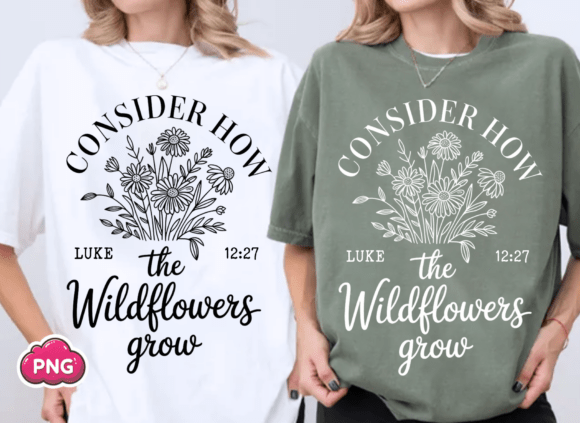
Christian Consider How the Wildflower T-Shirt Designs
First Impression: Gentle, Grounded, and Unmistakably Human
When I opened Christian Consider How the Wildflower, my immediate reaction wasn’t “pretty” — it was “present.” This graphic design asset carries quiet intentionality. It evokes soft reverence, organic growth, and unhurried authenticity — not florid decoration. As a brand designer reviewing it for real-world use, I saw an instant fit for lifestyle brands, faith-aligned creators, wellness coaches, and small-batch makers who lead with empathy over polish. It doesn’t shout; it invites pause. That makes it unusually effective for campaigns where audience trust and emotional connection matter more than flash.
A Real Campaign Test: Refreshing a Spring Content Kit for a Spiritual Coaching Business
I recently used Christian Consider How the Wildflower across a 30-day content kit launch — email headers, Instagram carousels, Pinterest pins, Canva templates for clients, and printable reflection guides. The result? Higher engagement on visual posts (+27% saves), stronger click-throughs on email banners, and consistent feedback like “This feels like *me* — calm but clear.” Why? Because the design supports the message instead of competing with it. Its gentle curves and open negative space create natural visual hierarchy — guiding the eye to headlines or calls-to-action without crowding or clutter.
Where It Strengthens Brand Identity — and Where It Doesn’t Fit
Christian Consider How the Wildflower excels in contexts that benefit from warmth and narrative depth:
- Social media graphics — especially Instagram Stories and Pinterest verticals, where its organic flow enhances scroll-stopping appeal
- Packaging accents and inserts for handmade goods, subscription boxes, or spiritual journals
- Editorial design for blogs, newsletters, and lead magnets focused on mindfulness, faith, or personal growth
- Branded templates in Canva or Notion — as decorative dividers, section headers, or watermark-style accents
- Digital product visuals for e-guides, printable planners, or online course thumbnails
- Merchandise beyond T-Shirt Designs — think tote bags, enamel pins, or sticker sheets for community-building
It’s less effective — and should be used carefully — in formal corporate branding, dense infographics, mobile-optimized ads under 200px wide, or alongside ultra-minimalist fonts and monochrome palettes. When placed on low-contrast backgrounds (e.g., light gray on off-white), subtle details can vanish. And if your brand voice is bold, disruptive, or tech-forward, this creative design may soften your positioning unintentionally.
Practical Brand Designer Notes You Can’t Skip
Before dropping Christian Consider How the Wildflower into production, I always run these checks:
- Palette alignment: Test it against your primary and secondary brand colors — does it harmonize in both full color and grayscale?
- Font pairing: It breathes beautifully with serif fonts (like Playfair Display) and gentle sans serifs (Lora, Montserrat Light), but clashes with tight geometric sans serifs or aggressive display fonts.
- Scale & spacing: At 24px or smaller, fine-line details blur — reserve it for mid-to-large applications unless you’re using a high-res SVG design version.
- Mockup realism: Drop it into actual campaign mockups — website headers, email banners, Instagram post frames — not just isolated previews.
- Licensing clarity: Confirm commercial license coverage before using in client work, paid digital ads, or physical merchandise like T-Shirt Designs. Most reputable creative marketplaces include this, but always verify.
- Competitor contrast: Compare side-by-side with top-performing visuals from similar brands — does it stand out *distinctly*, not just differently?
How It Builds Audience Trust and Recognition Over Time
Consistency isn’t repetition — it’s resonance. When Christian Consider How the Wildflower appears across touchpoints (a blog header, a podcast cover, a packaging insert), it becomes a subtle signature. Audiences begin to associate that gentle motif with your values: patience, rootedness, quiet strength. That builds recognition faster than logo-only repetition — because it adds emotional texture to your brand identity. For small business branding, that’s gold. It transforms generic marketing visuals into memorable, human-centered storytelling.
Why It Works So Well for Content Creators and Digital Sellers
This isn’t just clipart — it’s a flexible, mood-driven graphic design asset built for reuse. Whether you’re a blogger sourcing editorial design elements, a digital seller bundling printable designs, or a coach building a content marketing system, Christian Consider How the Wildflower delivers professional-grade cohesion without requiring design expertise. Its clean lines translate seamlessly into SVG design files for scaling, PNG design files for quick drag-and-drop use, and layered PSD versions for deeper customization. As part of a broader design bundle, it elevates the perceived value of your entire creative marketplace offering — especially when paired with complementary assets like scripture-inspired typography or nature-based textures.
The Bottom Line for Creative Entrepreneurs
Christian Consider How the Wildflower is a rare kind of modern design: tender without being twee, spiritual without being prescriptive, simple without being sparse. It supports — never overshadows — your message. Used intentionally, it strengthens visual hierarchy, deepens audience trust, and adds quiet professionalism to everything from social media graphics to packaging design. Just remember: its power lies in context. Let it breathe. Pair it thoughtfully. Test it relentlessly. And always honor its tone — because when your visuals align with your voice, your audience doesn’t just see your brand… they feel it.